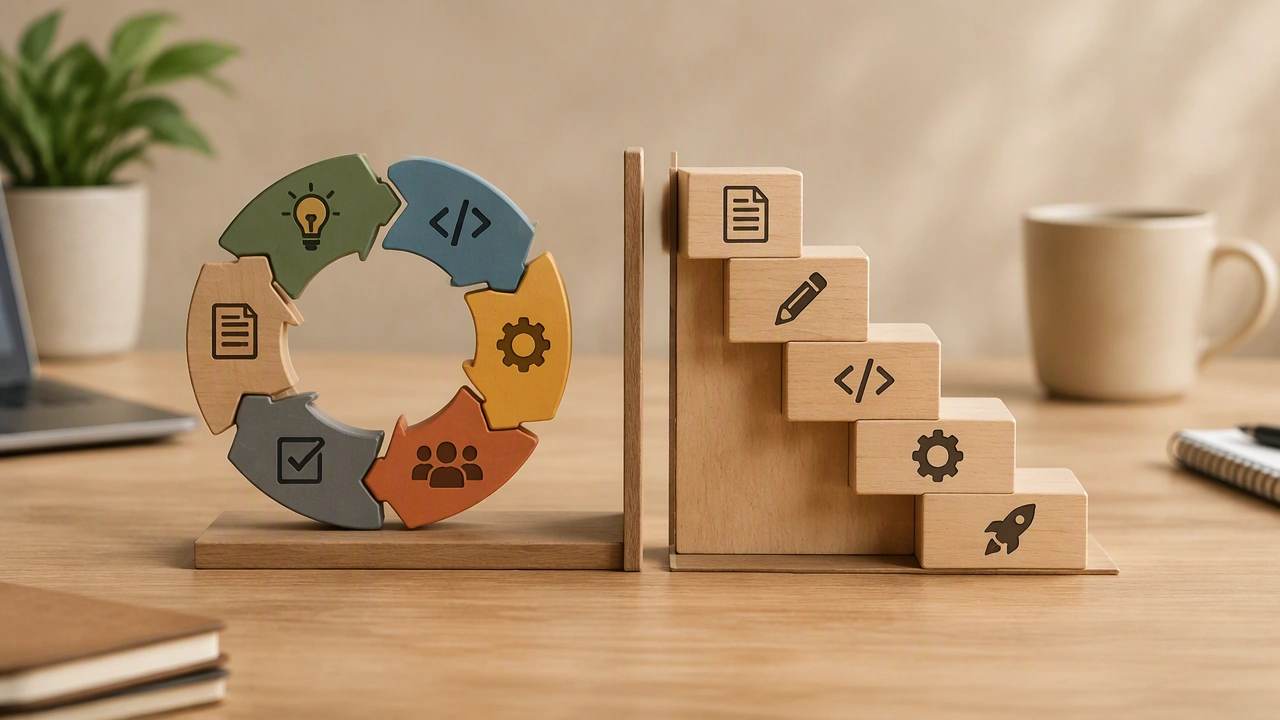
Agile vs Waterfall: Choosing the Right Methodology for Your Software Development Project

Choosing how your team plans, builds, and ships is one of the most consequential early decisions in software development. The agile vs waterfall methodology differences and when to use each are not just academic: they shape delivery speed, quality feedback loops, stakeholder communication, and how much change your process can absorb without derailing a release. This article explains how each approach works, where they excel, and how to decide with confidence.
What waterfall actually optimizes
Waterfall organizes work into sequential phases such as requirements, design, implementation, testing, and deployment. Each phase is intended to complete before the next begins, producing signed-off artifacts that act as contracts between groups. This structure optimizes for predictability, compliance, and clear handoffs. When the problem is well understood and the environment is stable, waterfall can reduce ambiguity because everyone knows what is in scope and what is not.
Waterfall tends to suit projects with fixed regulatory constraints, hardware dependencies, or fixed-bid contracts where scope, budget, and timeline are negotiated up front. It also fits teams that must coordinate many external approvals or that deliver large, infrequent releases with minimal post-release iteration. The trade-off is that late discovery of defects or changing market assumptions becomes expensive, since rework cuts across multiple completed phases.
What agile actually optimizes
Agile organizes work into short iterations that produce a potentially shippable increment. Instead of heavy upfront specification, agile emphasizes working software, continuous feedback, and adaptive planning. Product backlogs are refined regularly, priorities shift as learning accumulates, and cross-functional teams own outcomes from design through deployment.
Agile optimizes for learning speed and risk reduction. By releasing smaller slices of value and measuring them, teams validate assumptions early and change direction without massive rework. The cost is a higher communication burden and the need for strong product ownership. Agile does not remove discipline; it relocates it from detailed upfront plans to disciplined execution, frequent inspection, and relentless prioritization.
Key differences teams actually feel
- Planning horizon: Waterfall plans most work up front; agile plans near-term in detail and keeps long-range themes flexible.
- Feedback cadence: Waterfall gathers feedback at milestones; agile seeks feedback every iteration.
- Risk profile: Waterfall concentrates risk toward integration and acceptance; agile spreads risk across frequent increments.
- Change tolerance: Waterfall treats change as a formal event; agile expects and budgets for change.
- Documentation: Waterfall emphasizes comprehensive specifications; agile favors just-enough documentation that supports delivery.
- Team structure: Waterfall often uses specialist handoffs; agile prefers cross-functional teams with shared ownership.
When waterfall is the better fit
Choose waterfall-like approaches when requirements are stable and verifiable, when external constraints demand extensive upfront design, or when the cost of late change is extreme. Construction-like system integrations, safety-critical components with fixed standards, and procurement-bound projects often benefit from phase gates and formal sign-offs. Waterfall can also be practical when you must commit to a fixed scope and fixed price, and when stakeholders require a detailed plan before funding continues.
A common misconception is that waterfall means no testing until the end. Mature teams still test within each phase. The distinction is that testing is planned against a largely frozen specification, and major scope changes are handled through change control rather than backlog reprioritization.
When agile is the better fit
Agile is strongest when the problem is complex, the market moves quickly, and user feedback is essential to success. Product teams building customer-facing applications, data-driven features, or experiences that depend on usability insights benefit from short iterations and frequent releases. Agile also fits organizations that can invest in continuous delivery practices, because frequent releases amplify the value of fast feedback.
Agile works best when product ownership is active, when stakeholders can engage regularly, and when the team can make technical decisions quickly. If your organization can support small batch work, automated testing, and incremental design, agile reduces the risk of building the wrong thing for too long.
How to decide without ideology
Start with four practical signals.
- Requirement stability: If core requirements rarely change and are well understood, waterfall can be efficient. If requirements are emergent, agile reduces waste.
- Regulatory and contractual constraints: Fixed compliance artifacts and formal change control favor waterfall. Flexible scope and outcome-based contracts favor agile.
- Release cadence and operations: Infrequent, large releases with heavy validation align with waterfall. Frequent, small releases with automated pipelines align with agile.
- Team topology and skills: Specialist silos and external dependencies fit waterfall handoffs. Cross-functional teams with DevOps capabilities fit agile flow.
Many organizations land on a hybrid. For example, a program may use a waterfall-style planning and governance layer at the portfolio level while individual teams execute in two-week sprints. The key is to make the hybrid explicit, with clear rules for how scope is baselined, how changes propagate, and how progress is measured.
Making your chosen approach work in practice
Regardless of methodology, certain disciplines drive results. Define a thin, end-to-end slice of value early so you can integrate and learn. Invest in automated testing and continuous integration to make quality repeatable. Make work visible with a shared backlog or plan, and limit work in progress to protect flow. Agree on cadence for reviews and retrospectives, and use them to improve, not to perform.
For waterfall, strengthen your risk management with frequent integration checkpoints and prototype-driven learning where feasible. For agile, protect scope coherence by maintaining a clear product goal and by sequencing enablers alongside features. In both cases, align metrics to outcomes: delivery predictability, defect rates, cycle time, and customer impact are more informative than activity metrics.
A simple decision heuristic
If you can release monthly or more often, have access to users, and expect requirements to evolve, agile will likely serve you well. If you must commit to a fixed scope, satisfy formal gates, and manage extensive external dependencies, waterfall may be safer. If you have elements of both, adopt a hybrid with explicit policies so teams do not get caught between two playbooks.
The goal is not to pick a label. The goal is to choose the workflow that best reduces the risks your project actually faces, while giving your team a clear path from idea to value.